


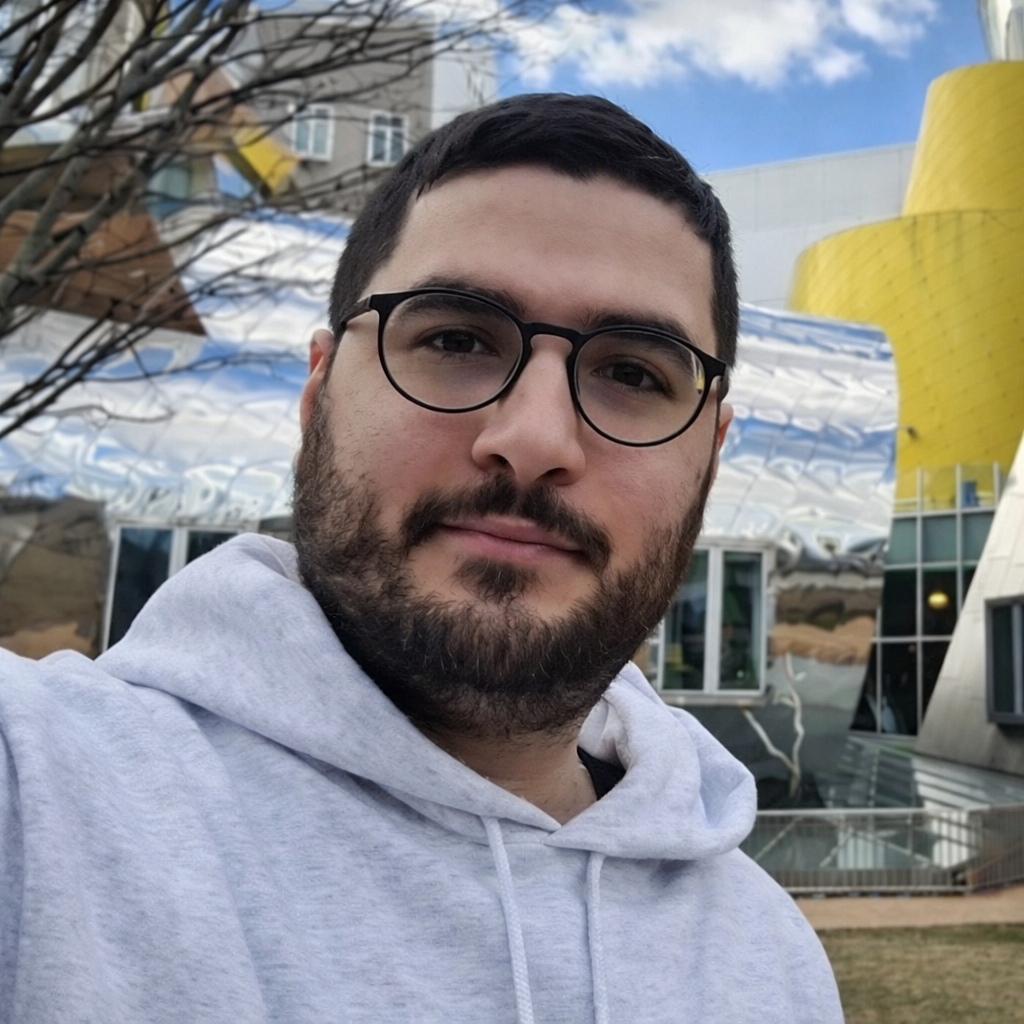
Dr. Alaa Maalouf
Neubauer Assistant Professor of Computer Science Department
Research areas:
- Efficient AI: He develops methods that optimize the full machine-learning stack—compressing data and models, accelerating training, and enabling fast, low-cost inference with reduced memory and energy requirements. The goal is to make high-performing AI practical and accessible, including on resource-constrained and edge deployments for everyone!
- Physical AI: He builds structured world models that allow embodied agents to perceive, reason, and act in the physical world, akin to humans. This includes learning representations and dynamics that support robust interaction and planning in settings such as autonomous driving and navigation, field robotics, and humanoid systems—bridging perception, prediction, and decision-making.
- AI for Scientific Discovery: He applies AI and robotics to automate data collection and generate grounded scientific hypotheses. A major focus is Project CETI, where autonomous robots and computer-vision pipelines help collect, curate, and annotate whale behavioral data, and machine-learning models integrate multimodal signals to infer interpretable structure in whale communication and social behavior—advancing both marine science and the foundations of data-driven discovery.
Dr. Alaa Maalouf is the Neubauer Assistant Professor of Computer Science at the University of Haifa, where he is the director of the GOATS Lab (Generalizable & Optimized AI for Technology and Science). He is also a Research Affiliate at MIT CSAIL, an Associate at Harvard SEAS, and a Principal Investigator in Project CETI.
Previously, he was a postdoctoral associate at MIT CSAIL, working with CSAIL Director Prof. Daniela Rus. Before that, he completed his PhD under the supervision of Prof. Dan Feldman at the University of Haifa.
In addition to academia, Dr. Maalouf spent five years in industry, serving as a Lead ML Researcher at Data Heroes Ltd. and as a chip-design engineer at Mellanox Technologies (now part of NVIDIA). During his PhD and postdoctoral work, he also collaborated extensively with industry on real-world problems, including projects with Samsung Research (leading to the outstanding paper award honorable mention at NeurIPS), the Toyota Research Institute, and several startups.
His recognitions include the Israeli Council for Higher Education (CHE) MAOF award for excellent young faculty, a Neubauer Family Foundation Fellowship (grant), a NeurIPS Spotlight, a NeurIPS Best Paper Honorable Mention, an Outstanding Reviewer award at CVPR, and more. He is also a TEDx speaker.
His research focuses on efficient and generalizable AI, physical AI (world models for robots), and AI for scientific discovery.
Dr. Alaa Maalouf
Neubauer Assistant Professor of Computer Science Department
Research areas:
- Efficient AI: He develops methods that optimize the full machine-learning stack—compressing data and models, accelerating training, and enabling fast, low-cost inference with reduced memory and energy requirements. The goal is to make high-performing AI practical and accessible, including on resource-constrained and edge deployments for everyone!
- Physical AI: He builds structured world models that allow embodied agents to perceive, reason, and act in the physical world, akin to humans. This includes learning representations and dynamics that support robust interaction and planning in settings such as autonomous driving and navigation, field robotics, and humanoid systems—bridging perception, prediction, and decision-making.
- AI for Scientific Discovery: He applies AI and robotics to automate data collection and generate grounded scientific hypotheses. A major focus is Project CETI, where autonomous robots and computer-vision pipelines help collect, curate, and annotate whale behavioral data, and machine-learning models integrate multimodal signals to infer interpretable structure in whale communication and social behavior—advancing both marine science and the foundations of data-driven discovery.
Dr. Alaa Maalouf is the Neubauer Assistant Professor of Computer Science at the University of Haifa, where he is the director of the GOATS Lab (Generalizable & Optimized AI for Technology and Science). He is also a Research Affiliate at MIT CSAIL, an Associate at Harvard SEAS, and a Principal Investigator in Project CETI.
Previously, he was a postdoctoral associate at MIT CSAIL, working with CSAIL Director Prof. Daniela Rus. Before that, he completed his PhD under the supervision of Prof. Dan Feldman at the University of Haifa.
In addition to academia, Dr. Maalouf spent five years in industry, serving as a Lead ML Researcher at Data Heroes Ltd. and as a chip-design engineer at Mellanox Technologies (now part of NVIDIA). During his PhD and postdoctoral work, he also collaborated extensively with industry on real-world problems, including projects with Samsung Research (leading to the outstanding paper award honorable mention at NeurIPS), the Toyota Research Institute, and several startups.
His recognitions include the Israeli Council for Higher Education (CHE) MAOF award for excellent young faculty, a Neubauer Family Foundation Fellowship (grant), a NeurIPS Spotlight, a NeurIPS Best Paper Honorable Mention, an Outstanding Reviewer award at CVPR, and more. He is also a TEDx speaker.
His research focuses on efficient and generalizable AI, physical AI (world models for robots), and AI for scientific discovery.